


Mountain Goat
Mountain Goat
The mountain goat, also known as the Rocky Mountain goat, is a hoofed mammal endemic to mountainous areas of western North America.

The mountain goat is an even-toed ungulate of the order Artiodactyla and the family Bovidae (along with antelopes, gazelles, and cattle). It belongs to the subfamily Caprinae, along with true goats, wild sheep, the chamois, the muskox and other species. The takins of the Himalayan region, while not a sister lineage of the mountain goat, are nonetheless very closely related and almost coeval to the mountain goat; they evolved in parallel from an ancestral goat. Other members of this group are the bharal, the true goats, and the Himalayan tahr. The sheep lineage is also very closely related, while the muskox lineage is somewhat more distant. The mountain goats probably diverged from their relatives in the late Tortonian, some 7.5 to 8 million years ago.
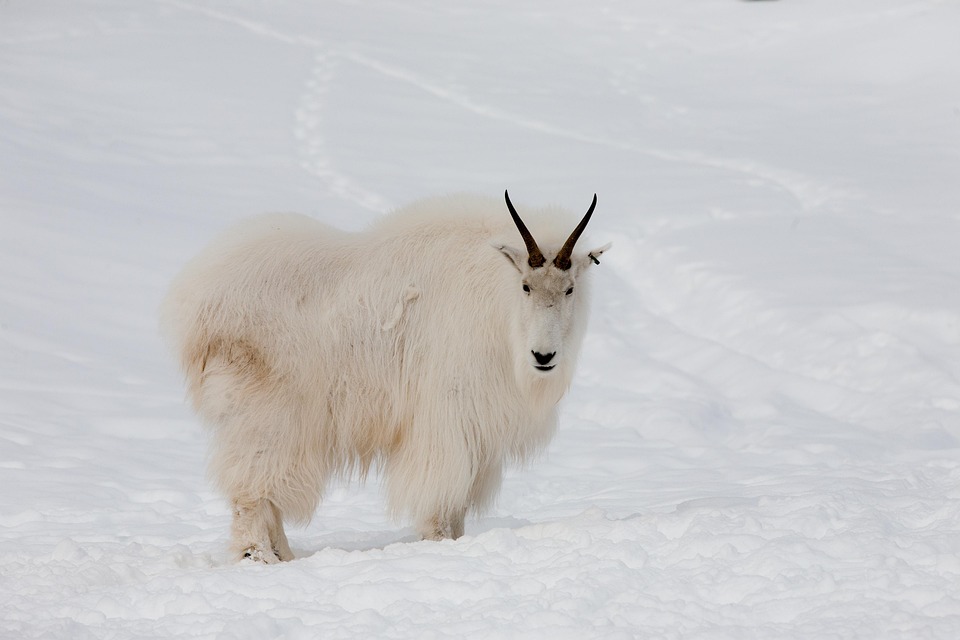

A male goat stands about 1 m (3.3 ft) at the shoulder to the waist and can weigh considerably more than a female (around 30% more in some cases). Male goats also have longer horns and longer beards than females. Mountain goats can weigh between 45 and 140 kg (99 and 310 lb), and billies will often weigh less than 82 kg (180 lb). The head-and-body length can range from 120–179 cm (47–70 in), with a small tail adding 10–20 cm (3.9–7.9 in).